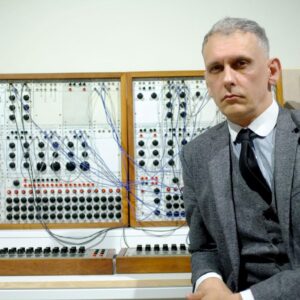
Giorgio Sancristoforo (Milan, 1974) is a sound artist, software designer, researcher, educator and filmmaker. His work spans twenty-five years of electronic music in all its forms: as a sound engineer, as a designer of instruments, as a documentary maker, as a composer and performer, and, since 2018, as a sci-artist working with radioactivity, particle physics and genomics.
Beginnings
He came to electronic music from the guitar and the organ. In the early 1990s he played psychedelic and indie music in the wake of Spacemen 3 and Stereolab; his first synthesizer was a Moog Prodigy (1992), his first modular a Doepfer A-100 (1995). At the end of the decade he moved to jungle, ambient and, after discovering Oval, to glitch and electroacoustic music. He graduated as a sound engineer at SAE College Milan in 2001, trained at the THX-certified post-production facility Marinastudios, and worked for several years as an audio engineer, sound designer and video editor in music and advertising. He has used Max/MSP since 2000 and began teaching sound synthesis and sound design at SAE Institute Milan in 2001.
Documentaries
In 2006 he left advertising to write and direct documentaries. For QOOB, the experimental digital channel of MTV Italy, he created Tech Stuff (2007), a series of short films that tell the history of electronic music through its inventors and instruments: the theremin, musique concrète, the RAI Studio di Fonologia in Milan, Stockhausen and Berio, Pansonic, Jürgen Michaelis of JoMoX, drum machines and generative music. The series includes a two-hour interview with Karlheinz Stockhausen recorded in his studio in Kürten a few months before his death. Tech Stuff was published by Isbn Edizioni as a DVD + book, with a companion volume, Tech Stuff Insider, and a sound-synthesis tutorial software, Generator X1.
Software
Since 2005 he has designed and distributed standalone music software, written in Max/MSP and sold directly from his website. The choice of standalone applications over plugins is deliberate: each program is conceived as a complete instrument with its own logic, rather than a tool inside a DAW.
- Gleetchlab (2005; versions 2, 3, 4, X and Gleetchlab2021) is a modular DAW without a timeline, designed for glitch and experimental music: sound is processed and reprocessed in real time through a matrix of granular, spectral, convolution and feedback modules, with surround output.
- Berna (2009, 2013, 2021) is a simulation of a late-1950s electronic music studio, a tribute to the RAI Studio di Fonologia of Milan and the WDR studio of Cologne, built from function generators, filters, modulators and tape recorders. Conceived as a teaching tool, it is used in electronic music classes at Tufts University, the Royal College of Music in Stockholm and many other schools.
- Substantia (2020) is a physical-modelling laboratory with 368 resonant models combining sixteen shapes and twenty-three materials, from aluminium to uranium, playable with contact microphones.
- Bentō (2022) and Ongaku (2022) are noise boxes and West Coast synthesizers driven by probabilistic clocks; Mille (2023) is a 1000-oscillator quadraphonic drone synthesizer; No-Fi (2023) a cassette tape-loop studio; Full Blotter (2024) an ambient drone generator; Nakama (2024) a surround looper/delay with progressive tape disintegration; Creature From the ID (2024) an emulation of Louis and Bebe Barron’s self-generating circuits of Forbidden Planet, built only with 1950s techniques; Homework (2026) a four-track tape workstation with two modular synthesizers.
- Haiku (2026), released under the 大雨-Ooame project, is a new format: a generative music album distributed as a macOS application, which composes itself anew every time it is opened and never plays the same way twice.
His software has been used in more than forty countries by artists and institutions including Curtis Roads, Ben Frost, Ryuichi Sakamoto, Richie Hawtin, Taylor Deupree, Robert Lippok, Stanford’s CCRMA, the BBC Radiophonic Workshop, Tufts University, San Diego City College and the Centro Nacional de las Artes of Mexico City.
Synthesis research
He is the author of two original sound synthesis techniques. TAMS (Tri-Axis Modal Synthesis) is a modal technique for physically modelled percussive and resonant sounds. Tropical Additive Synthesis, developed with mathematician Cristiano Bocci of the University of Siena, is the first computer music technique based on tropical algebra, a non-standard mathematics in which addition and multiplication are replaced by minimum and sum. Both are implemented in Gleetchlab.
Sound art and installations
In 2010 he joined AGON, the Milan centre for contemporary music founded by Luca Francesconi and Pietro Pirelli, where he worked on interactive installations and as music assistant to composers. His first project there, audioscanMILANO (2009–2010), supported by Fondazione Cariplo, was a sound map of the city: fifty hours of recordings and sound-level measurements in 1,580 streets inside Milan’s outer ring road, turned into an interactive touchscreen map and into an electronic suite composed with Giuseppe Cordaro, with video by Quayola. The installation was exhibited at Palazzo Reale in May 2010, the live performance was presented at the Palazzo del Ghiaccio and at the MAGA museum in Gallarate, and the City of Milan chose the music as its official soundtrack for Milan Week at Expo Shanghai 2010. The project was published as a bilingual book + CD by Postmedia Books.
His installations and performances have been hosted by the National Museum of Science and Technology of Milan, Teatro Valli (Reggio Emilia), Piccolo Teatro Studio (Milan), Arena del Sole (Bologna), Tempo Reale (Florence), Accademia Filarmonica Romana, Onedotzero and Lovebytes (UK), NEMO and Le Cube (France), IDAP (China and Japan). Between 2010 and 2012 he performed live with a Buchla 200e, a Music Easel, an EMS Synthi A and a Make Noise system, before returning entirely to software.
Sci-art: radiation, particles and the genome
Since 2018 his work has concentrated on a single theme: mutation, in the sense of the Heraclitean panta rhei, explored through nuclear physics and genomics. As artist in residence at the European Commission’s Joint Research Centre in Ispra (Datami A.i.R., Resonances III festival), he worked with the JRC’s Nuclear Security, Biochemistry and Genomics, and Health & Consumer Safety units. There he developed the Phonosomic Code, a base-4 numerical translation of DNA coding sequences that turns the genome into a programming language for sound and video, and Ray of Light, a multichannel analyser written in Max that converts the gamma spectrum of a radioactive source into a timbre, so that every isotope has its own sound. Radiation Grooves (2019) models instruments on the fuel rods of the JRC’s ESSOR research reactor and drives them with radioactive decay.
The residency culminated in The Tannhäuser Gate (2019–2020), a nuclear and genomic installation: two steel pillars containing his sequenced genome, displayed on LED screens and converted to sound, and a sealed Strontium-90 source whose radiation, released when a visitor walks through the gate, mutates the DNA, the lights and the music according to the real mutation probabilities of the nucleobases. Curated by Freddy Paul Grunert and designed with Cristina Fiordimela, it was exhibited at JRC Ispra and at Bozar, Brussels. Since then he has been Expert Artist for the European Commission.
Later works extend the method to other phenomena: The Antimatter Experiment (2020), in which sounds are triggered by positron annihilation from a sodium-22 source; a modular synthesizer piece controlled by INFN cosmic-ray muon detectors (2020); Music for a Nuclear Reactor (2022), based on neutron flux recordings; and six years of gene-by-gene sonification of his own genome, collected in GENOMICS (2024) and developed into the live multimedia project Codex Naturae. He also produces autoradiographs and gamma images with radioactive materials.
In May 2023 he was invited by the Ernst Krenek Institut in Krems (Austria) to work on the original 1967 San Francisco Tape Music Center Buchla 100 that belonged to Ernst Krenek, recording a series of pieces and a video installation (Krenek’s Wald, Geschichte wiederholt sich, The Seventh Hour, Eclipse).
Memberships and teaching
He is a member of AGON (since 2010), of the Electronic Music Foundation (since 2010) and of the Prisma International Composers’ Group (since 2015). After twenty years of teaching sound synthesis, sound design and Max/MSP at SAE Institute, he is now professor of multimedia languages and new media, music technology and Max/MSP at NABA, IED and IES Abroad in Milan. He lectures and gives workshops in Italian and English, and his software is written with teaching in mind: tools that let students reconstruct, by hand, the history of electronic music outside the mass-market paradigm.
Tobor Experiment
Tobor Experiment is the musical project of Giorgio Sancristoforo, active since 2007 and published by Bear Funk Records, the London label run by Stevie Kotey (Chicken Lips).
The name first appeared as the signature of the Tech Stuff documentaries and of the self-released experimental albums Tenori Days (2008), Overall Patterns Elude Easy Perception (2009) and Tales from Dione (2010), recorded with the Tenori-on, Buchla and modular synthesizers. In the same years, under the extended name Tobor Experiment Disco Experience, the project turned to a different lineage: the Moog records of Claude Denjean and Jean-Jacques Perrey, Italian disco, the electronic pop of Air and Stereolab. The Disco Moog EP (2008) was followed by the album Tobor Experiment Disco Experience (2011), twelve tracks written, played and produced by Sancristoforo, from Postcards from a Nervous Breakdown and What’s It Like To Be There? to a cover of David Bowie’s Station to Station, and by The Remix Experience (2012), with remixes by Fabrizio Mammarella (Clap Rules) and Stevie Kotey. Tracks from this period appear on the Bear Funk compilations Rools For Rules and Hibernation.
After a twelve-year silence, Tobor Experiment returned in 2023 with Available Forms, a gatefold LP conceived as the soundtrack to a long-lost 1970s science-fiction television series. Jazz drums and hollow-body guitar meet Moog lines, vintage synth pads and nu-disco rhythms in what the label called “moogsploration”: Lowpass Risotto, Venus Modularistic Riff, Up!, Astounding Stories, Moonscape Dust, Monsters. Sancristoforo plays guitars, bass, keyboards and modular synthesizers; the record is published by Dharma Songs.
Where his sci-art installations deal with radiation, genomes and the physics of mutation, Tobor Experiment is the other side of the same sensibility: a retro-futurist love for the instruments and the imagined futures of the 1960s and 1970s, played by someone who has spent his life building new ones.