Haiku, a generative music album for Mac OS
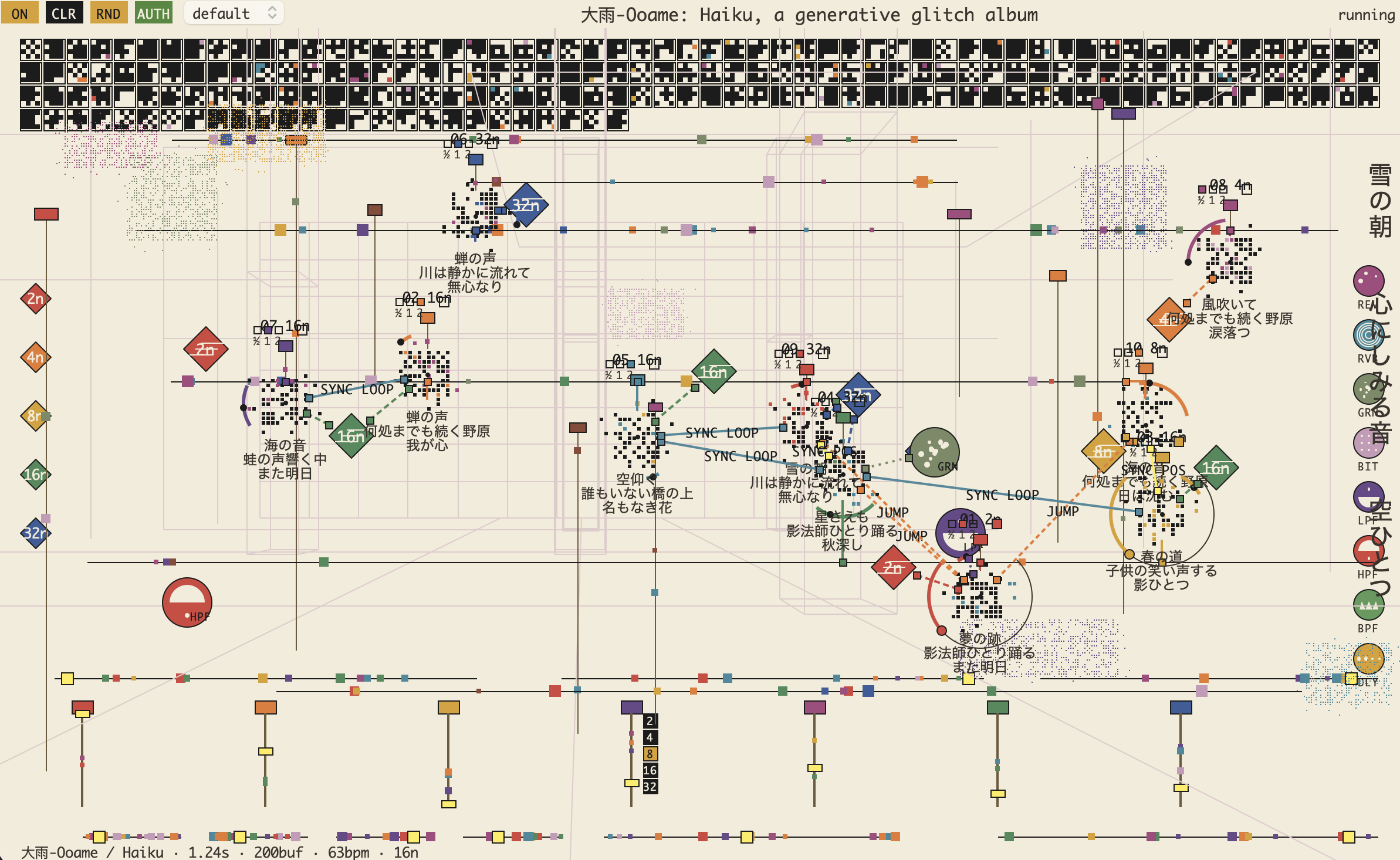
Haiku is not an instrument, it’s a music album in the form of software.
Haiku is a work of generative music that builds its own sound from nothing each time you open it,
and never plays the same way twice — a record that exists only while it is playing.
A record plays the same way every time. That is its nature, and for a century it has shaped how we listen: we return to a piece of music the way we return to a photograph, expecting to find it unchanged. Haiku does not work like this. It will never play the same way twice. There is no master take hidden somewhere inside it, no definitive version that the variations are departures from. Each time you open it, the work composes itself again, in front of you, and then it is gone.
I kept coming back, while making this, to a book by Umberto Eco — Opera aperta, the open work, written in 1962. Eco was looking at a particular kind of art: pieces that the author leaves deliberately unfinished, not out of carelessness but as a structural choice. He called some of them opere in movimento, works in movement — a Calder mobile that arranges itself in the air, a Mallarmé page, the scores of Berio and Stockhausen where the performer is handed not a fixed sequence but a field of possibilities and asked to move through it. The author of such a work does not build an object. He builds a system, a set of tendencies and constraints, and then hands the final act of composition to the moment.
That is the idea Haiku is built on. What I have authored is not a sequence of sounds but the conditions under which sounds occur: the sonic material, the rules that govern how it appears and decays and recombines, the proportions and probabilities that give the whole its character. Within that field, every performance is singular. The grains, the micro-events, the way a texture thickens or thins — these are decided, each time, by the work itself in the instant of playing. I have set the boundaries of what can happen. What actually happens is never quite the same.
This also changes your position as a listener. You are not receiving a finished thing; you are present at its making. And if you wish, you can reach into the field yourself — the controls in this application are not effects applied to a recording but the parameters of the work in motion, the dials that shift its weather. Move them and you are no longer only listening. You are, in Eco’s sense, performing and completing the work.
A last thing follows from all of this, and it matters. Because Haiku is a work in movement, no single moment of it can be captured and carried off without ceasing to be what it is. What you hear belongs to the time you hear it.
NOW AVAILABLE FOR MAC OS (M Processors native, won’t work on Intels)
Dowload HAIKU 1.0 for M processors
Minimum system requirements: MacOS 14 (Sonoma) with M processor and 8 or 16GB RAM
The demo plays for 10 minutes, then must be restarted
Permanent license price*: 20€
BUY NOW WITH PAYPAL
*READ CAREFULLY
1.1 “大雨 — Ooame / Haiku” is a WORK OF GENERATIVE MUSIC: an original musical
and artistic work authored by Giorgio Delfo Sancristoforo and protected by
copyright and related rights.
1.2 The Work is distributed in the form of a software application
The Application is merely the medium through which the Work
is performed and rendered to the listener, in the same way that a vinyl
record, a compact disc, or a streaming file is the medium of a traditional
music album. The Application is an inseparable part of the Work.
1.3 The Work is NOT a music-production tool, a sound library, a sample pack, a
synthesizer, or an instrument intended to create third-party works. It is a
finished artistic work meant to be experienced (listened to) by the
Licensee. Any functionality that produces, varies, or arranges sound is an
internal expressive component of the Work itself, not a feature offered for
the creation of other works.
Previous 大雨 — Ooame Discography::::::::::